Search Your Journal From Chat Instead of Asking the Same Question Twice
Some conversations with AI are useful in the moment.
Others stay with you.
A clear explanation. A plan that calms you down. A note that helps you begin. A thought you want to keep close.
And yet even the most helpful answer can disappear quickly. It gets buried under newer chats, mixed into half-finished threads, or remembered only as a feeling: there was something good there, but I cannot quite find it now.
That is where a journal changes things.
Truffle Journal is not about saving everything. It is about keeping the parts that matter, and making it easier to return to them when you need them again.
Chat history is not the same as recall
A chat timeline is good for conversation.
It is not always good for recall.
When you want to revisit something useful later, you usually do not remember the exact wording. You remember the shape of it.
Maybe it was the explanation that finally made a subject click. Maybe it was a meal plan you actually wanted to follow. Maybe it was a checklist that helped you get unstuck. Maybe it was a sentence you wanted to keep.
Most of the time, you do not want to start over.
You want to find what already helped you.
That is a quieter, more human way of thinking about AI. Not as endless output, but as something that can become part of your own system.
Search brings the useful things back
The value of saving is not in collecting more.
It is in being able to return.
Sometimes you remember the exact word. Sometimes you only remember the idea. Search makes room for both.
You might look for physics, or todo, or apartment, or meal prep. You might search for a phrase. You might only remember the feeling of what you are trying to get back to.
When that happens, the right note should not feel far away.
Search is what turns a saved journal into something living. It lets a good answer stay useful beyond the moment it was created.
And when you can search your journal from chat, you do not have to begin from zero each time. You can return to something that already mattered.
Your tags can grow naturally with you
You do not need to build the perfect system before you begin.
Tags can start small. They can be practical. They can change as your life changes.
Some people like a time-based rhythm: now, later, next-week.
Some people like a gentle way to mark what feels valuable: favorite, keep, revisit.
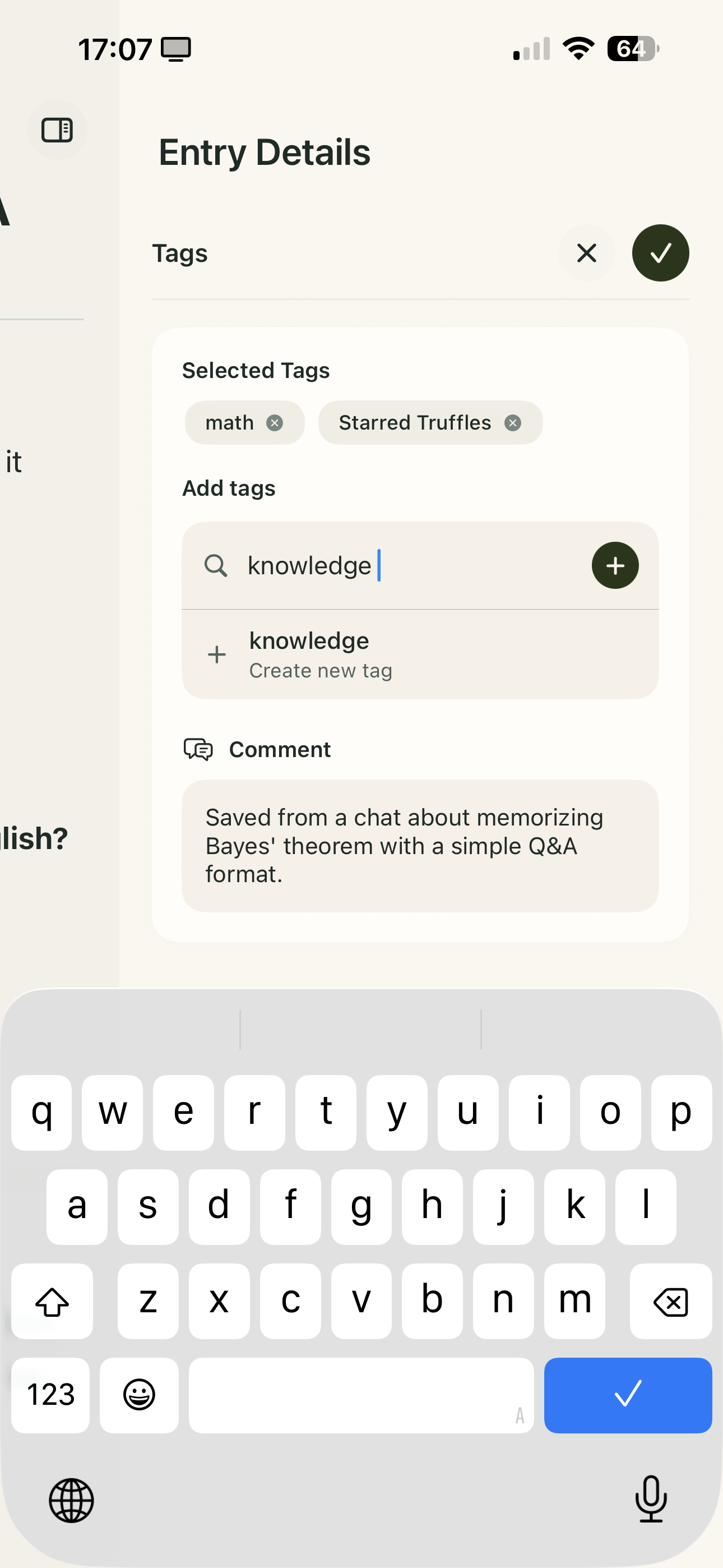
Students might organize by subject: math, physics, history.
There is no single right way to do it.
The best tags are simply the ones that help your future self return to something useful.
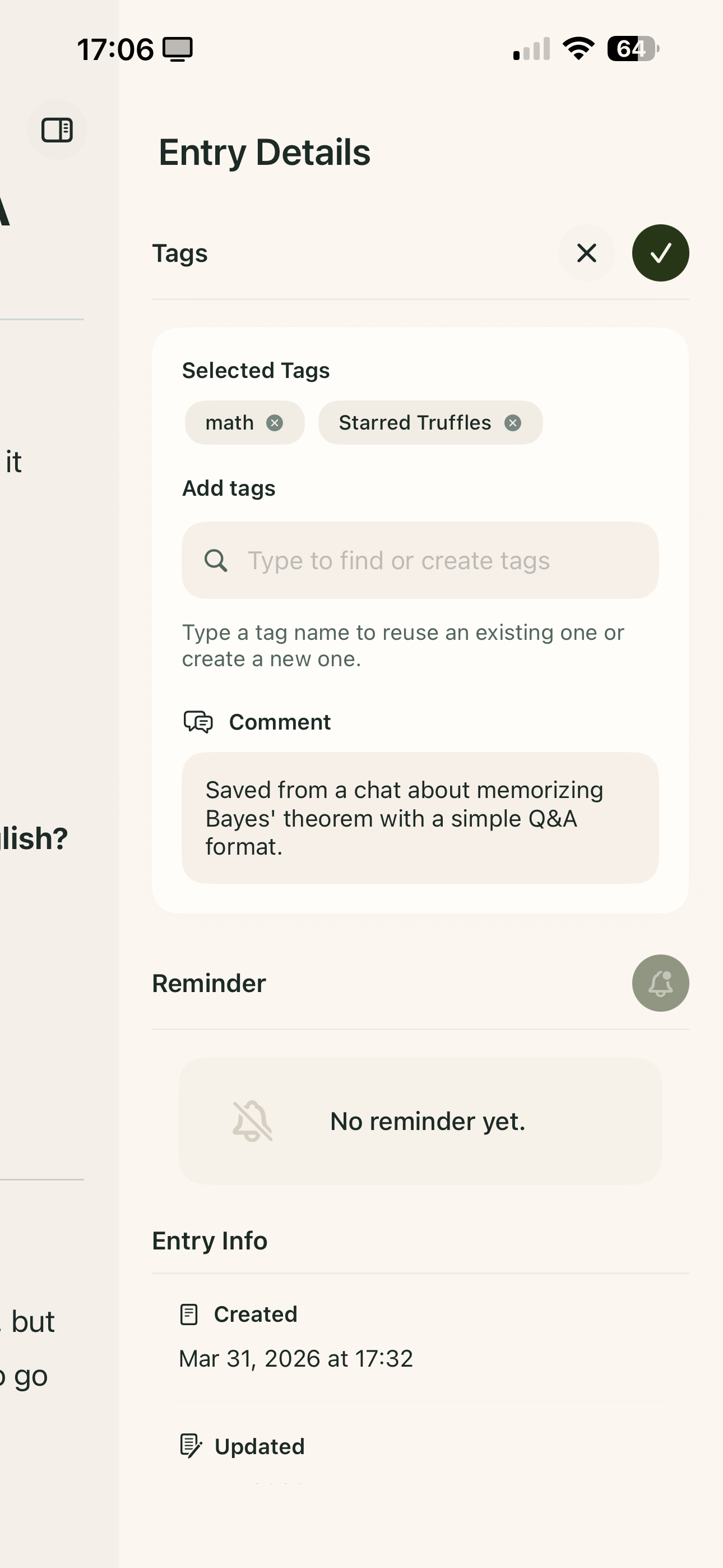
A tag can become a doorway
A tag does not have to do much at first.
Sometimes it is just a quiet note to yourself: this matters, come back to this, keep this close.
Over time, a tag can become more than a label. It can become part of your own system.
A todo tag can become a place where action items live. A favorite tag can become a place for the ideas you want to keep near. A physics tag can become a shelf for one subject you return to again and again.
And when a tag becomes part of your everyday flow, you can pin it in the tag panel so it stays close at hand.
That small detail matters more than it seems.
Because once a tag is easy to reach, it becomes easier to use. And once it becomes easier to use, it starts to feel natural. Not like organization for its own sake. More like a familiar path back to the things that matter.
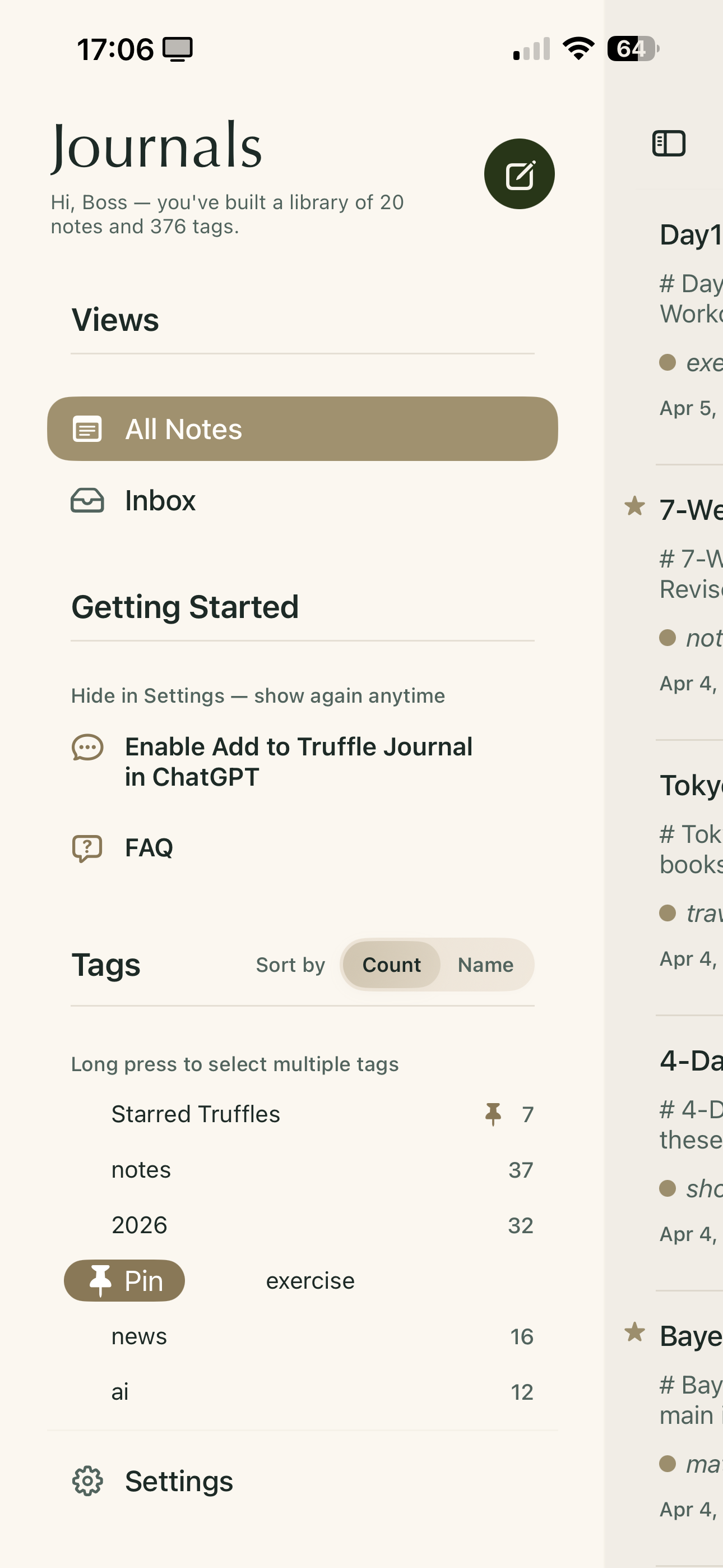
A simple system can become surprisingly powerful
This is part of what makes a flexible tag system so powerful.
It does not tell you how to think. It lets your own patterns become visible.
One person might pin todo, now, and next-week. Another might pin favorite, writing, and ideas. Someone else might pin math, physics, and exam-prep.
The system can become whatever is helpful: a study system, a task system, a creative system, a retrieval system, or some combination that only makes sense to you.
That is not a weakness.
That is the point.
The most useful systems are often the ones that feel personal enough to keep using.
Search and tags work beautifully together
Tags help you shape the journal. Search helps you return to it.
Together, they create a gentle kind of structure.
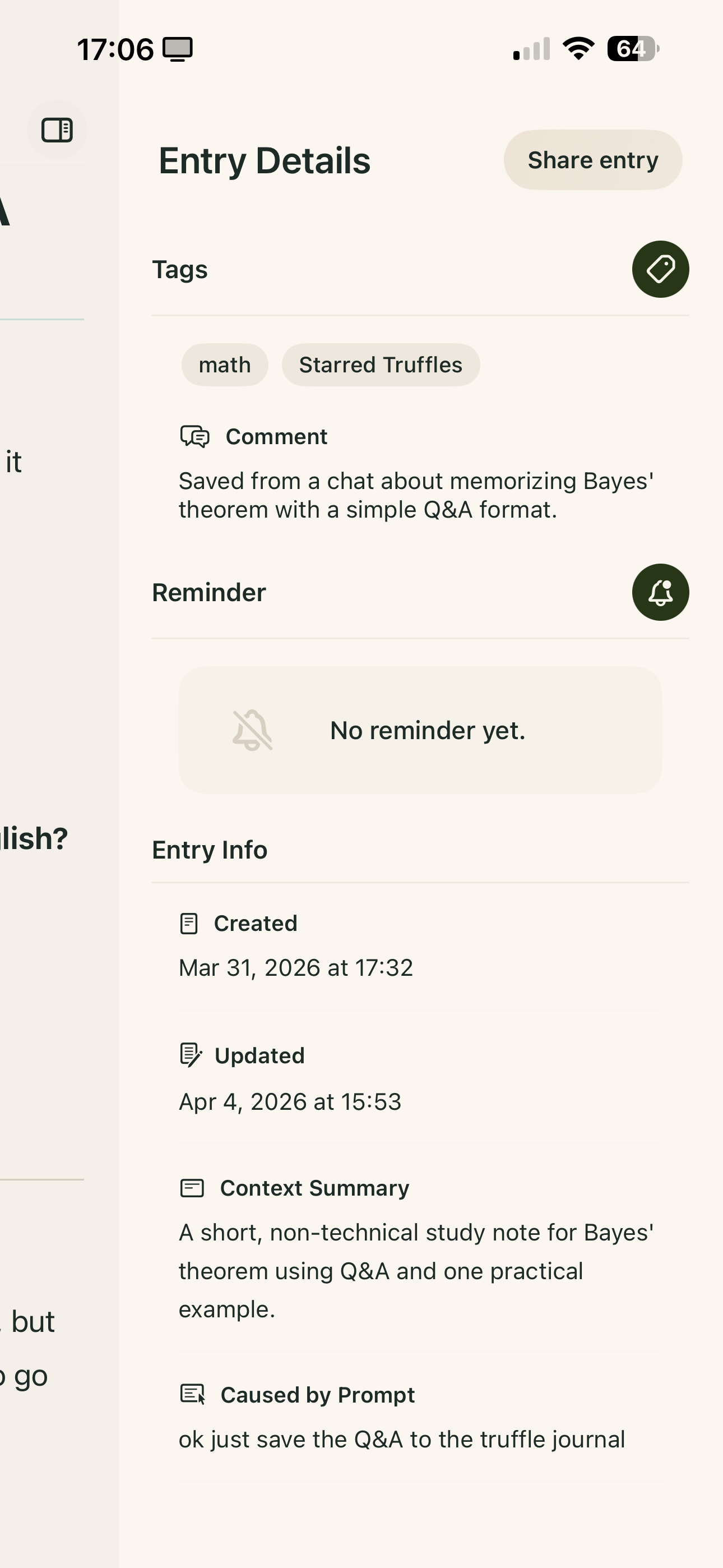
You save something useful. You add a note in your own words. You give it a tag that makes sense to you. Later, when you need it again, you can find it without rebuilding everything from scratch.
That changes the experience in a quiet but important way.
Instead of asking the same question again and again, you begin to build on your own history. Instead of hoping a useful answer appears again, you can return to the one that already mattered. Instead of treating AI like a stream, you begin to treat it like a space you can come back to.
For students, builders, and everyday life
This can look different for different people.
A student might save a clear explanation and tag it math and review. Later, that becomes part of how they study.
A builder might save research, phrasing, outlines, and decisions under tags like writing, product, or next-week. Later, those notes become momentum.
Someone using AI in everyday life might save meal plans, travel ideas, routines, shopping comparisons, or reminders under tags that fit the shape of daily life. Later, those small saves reduce friction.
The pattern is the same in all of them: something useful gets kept, then found again, then used at the right moment.
That is where the value compounds.
You do not need to save everything
In fact, it is often better if you do not.
Not every conversation needs to be kept. Not every answer needs a place in your journal.
But every once in a while, something does feel worth returning to.
A thought. A plan. A question. A sentence. A small piece of clarity.
Those are the moments worth keeping.
And once you can tag them, pin what matters most, and search when you need it, your journal stops feeling like storage.
It starts feeling like support.
Stop starting from zero
Sometimes the best AI answer is not the newest one.
Sometimes it is the one that already helped you last Tuesday. The one that made the subject click. The one that gave you a calmer plan. The one that helped you say what you meant. The one you do not want to lose.
That is why search matters.
Not because it gives you more information, but because it helps you come back to what was already meaningful.
Save the useful part. Tag it in the way that feels natural. Pin what you want close by. Search when it matters.
That is how a journal becomes more than a record.
That is how it becomes a companion.
Tags and search let you return to what already helped — without starting from zero every time.
Build your return path
You do not need a perfect organization system first. Start with a few saved entries and a small tag habit. Then search from chat when you need something back. The goal is not more storage. The goal is easier return.